

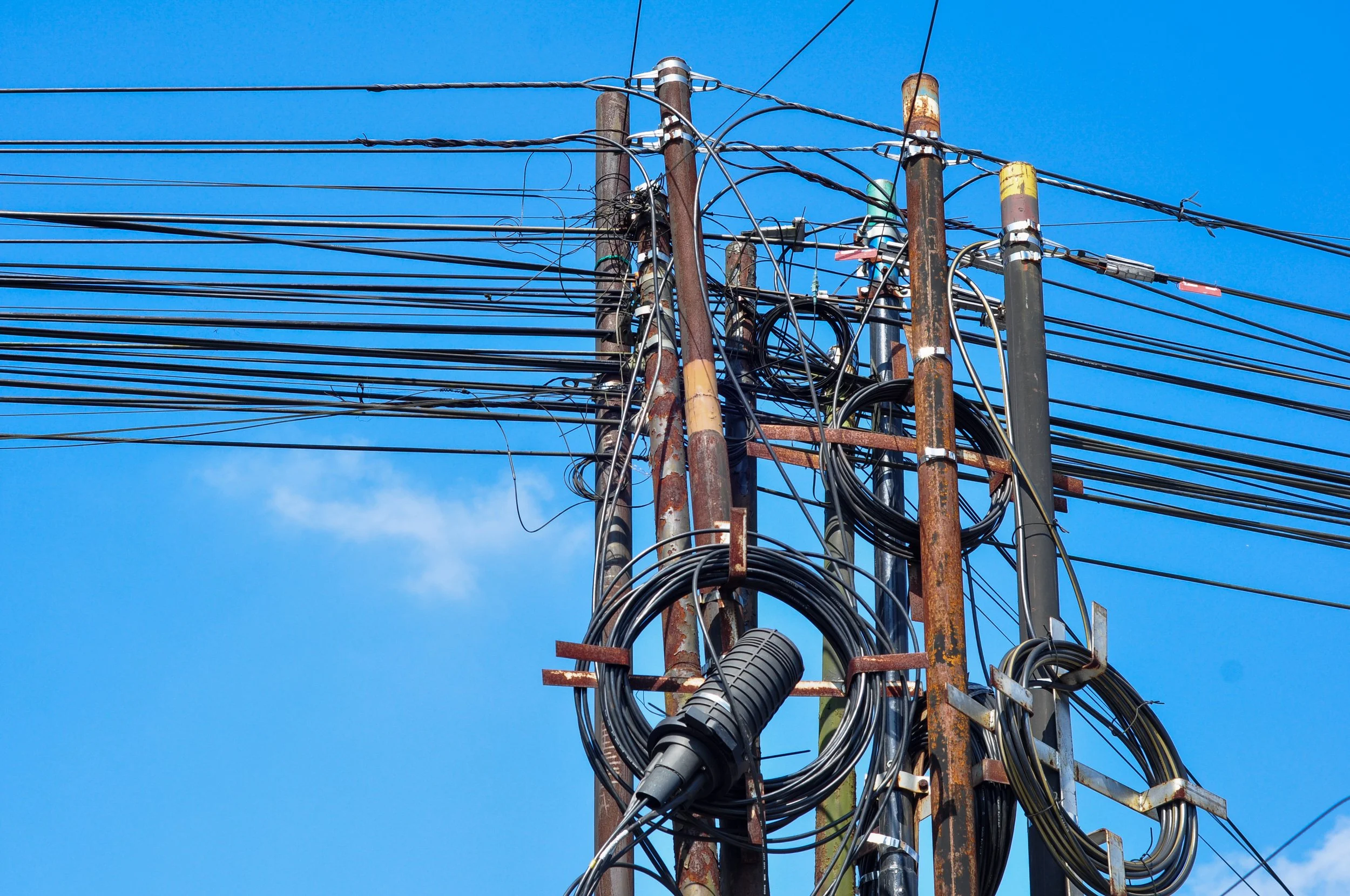
We have covered the pole attachment agreement that gives you the right to hang fiber on someone else's poles, and we have covered the NESC clearances that govern where your cable can sit once it is up. Between those two milestones sits a phase that decides whether your build runs on schedule or stalls for months. That phase is make-ready, and it is the part of an aerial project that most owners underestimate.
Make-ready is the engineering and construction work required to prepare a pole to accept a new attachment. It happens after the application is filed and before the strand goes up. When it is planned well, the crew shows up to poles that are ready and the build moves. When it is planned poorly, applications get rejected, poles come back needing more work than expected, and the schedule slips one utility review cycle at a time.
What Make-Ready Actually Means
Under the federal framework, make-ready is defined as the modification or replacement of a utility pole, or of the lines and equipment already on it, to accommodate an additional attachment. In plain terms, the pole has to have room, and it has to be structurally sound enough to carry one more line through wind and ice. If either condition is not met, something has to change before the fiber can go up.
That change can be small or large. It might mean lowering an existing communications line a few inches to open up clearance, or transferring an attachment from one position to another. It might mean replacing the pole entirely because it cannot carry the added load. The scope of that work is what make-ready engineering determines, pole by pole, before a single crew mobilizes.
The Sequence That Keeps a Build on Schedule
Aerial fiber deployment follows a sequence, and the order is not optional. The path runs from field survey, to pole loading analysis, to make-ready design, to the attachment application, to make-ready completion, and finally to strand installation. Every step feeds the next, and compressing or skipping a step almost always creates cost and schedule risk later.
The reason the sequence matters is that each stage produces the data the next stage depends on. A crew cannot lash strand onto a pole that has not been made ready. A pole cannot be made ready until the utility approves the design. The utility will not approve the design until it has a complete, accurate loading analysis. And the loading analysis is only as good as the survey data underneath it.
The Field Survey
The process starts with a field survey of every pole on the route. Survey crews record pole height, class, and condition, along with the height and type of every existing attachment, the power and communications equipment already present, and the exact location by GPS. Modern survey platforms geo-tag and photograph each pole so the data can be verified in the office rather than re-collected in the field.
Accuracy here is not a formality. If the survey misses an existing attachment or records a measurement incorrectly, the loading analysis built on top of it is wrong, and the utility will catch it. That means a rejected application and a return trip, which is exactly the kind of delay a well-run survey is meant to prevent.
Pole Loading Analysis
Once the survey is complete, each pole is modeled individually in structural analysis software to determine whether it can safely carry the new attachment. The analysis accounts for every load already on the pole, the added weight and wind surface of the new fiber, and the tension and framing forces acting on the structure, all measured against NESC strength and clearance requirements for the loading district.
There are no blanket pass assumptions. A pole that looks fine from the ground can fail the analysis once the added ice and wind load is calculated, and a pole that carries several existing lines may have no capacity left at all. The output is a clear determination for every pole: it passes as is, it needs rearrangement, or it needs replacement.
Simple Make-Ready Versus Complex Make-Ready
The regulatory framework draws a hard line between two kinds of make-ready, and that line drives your timeline. Simple make-ready is work in the communications space that can be done without a reasonable expectation of a service outage and without relocating existing equipment in ways that risk damage. Moving a communications line to open clearance is a typical example.
Complex make-ready is everything heavier. Replacing a pole is complex work by definition, as is any work reasonably likely to cause a service interruption or requiring relocation of equipment above the communications space. Complex poles take longer, cost more, and often involve coordination among the pole owner and every existing attacher on the structure. Knowing early which poles fall into which category is how you build a realistic schedule instead of an optimistic one.
One-Touch Make-Ready and the Regulatory Clock
For simple work in the communications space, federal rules allow one-touch make-ready, where the new attacher uses a utility-approved contractor to perform all of the simple make-ready in a single coordinated trip rather than waiting on each existing attacher to move its own equipment in sequence. That single change removed one of the largest sources of delay in aerial builds.
The clock around all of this is defined for poles governed by the federal rules. For a Regular Order, meaning a request up to the lesser of 300 poles or half a percent of the utility's poles in that state, the utility has ten business days to review the application for completeness, and defined windows follow for the survey, the estimate, and the make-ready work itself. Make-ready in the communications space runs on a compressed timeline compared with the older process, while work above the communications space is allowed more time. It is worth noting that some states set their own pole attachment rules rather than following the federal framework, so the exact deadlines depend on where you are building. Either way, make-ready is consistently the most time-intensive stage in the whole attachment process, which is why planning it early matters so much.
Why This Controls Your Schedule and Your Budget
The single biggest bottleneck in most aerial builds is not the fiber, the crew, or the permitting. It is the poles. When pole data is incomplete or a loading analysis is inaccurate, utilities reject the application, and every rejection means rework, a resubmittal, and another review cycle lost. For a build racing a grant deadline, those cycles add up quickly.
First-pass approval is the goal, and it comes from doing the upstream work correctly. That means a complete survey, an individual loading analysis for every pole, and a make-ready design that already meets the pole owner's standards before it is submitted. Cost follows the same logic. Identifying pole replacements and rearrangements during engineering, rather than discovering them mid-build, is what prevents change orders from rewriting the budget after construction has already started.
By the time the first bucket truck arrives on the route, the hard decisions should already be made. The poles should be surveyed, analyzed, designed, approved, and made ready. The crew that then installs the strand and lashing is executing a plan, not improvising one. Make-ready is the quiet phase that no subscriber ever sees, and it is the phase that determines whether everything after it goes smoothly.
