

Copper Retirement Got a Green Light. The Replacement Work Is Aerial
The largest source of new pole-line work in the country right now is not a grant program.
While the industry has spent two years watching federal broadband funding, the Federal Communications Commission quietly removed most of the friction that kept legacy copper networks hanging on utility poles long after they stopped earning their keep. Carriers have been waiting for this for a decade. Now they can move, and what they are moving toward is fiber on the same routes the copper occupies today.
For anyone who works above the road, that is a meaningful shift in where the next several years of work comes from.
What the FCC actually did
In March 2026 the Commission unanimously adopted an order easing the process of decommissioning copper networks. According to reporting on the order, it eliminated certain filing requirements around network changes and granted carriers blanket authority to grandfather legacy services provisioned over copper, including voice and lower-speed broadband, meaning those services are no longer offered to new customers.
The Commission followed with additional actions in April, including a clarification allowing providers to use streamlined procedures more often and waivers covering certain retirement and notification requirements.

The stated rationale is money. Carriers have been running two parallel wireline networks, and the FCC's position is that the changes free up substantial annual spending that was going into maintaining aging copper rather than building modern plant.
What did not change
Notice requirements survived, and they matter to anyone planning around this.
The FCC's guidance for government officials states that incumbent carriers must notify retail customers whose copper connection will be replaced by fiber to the premises. Notice runs at least 180 days for interconnecting entities and non-residential retail customers, and at least 90 days for residential retail customers. The Commission also requires notice directly to the governor, the state public utility commission, and Tribal governments at least 180 days before any retirement.
If you sit in a municipal office, that last sentence is the one to remember. Your state is getting formal notice well before your residents are.
Why this is aerial work
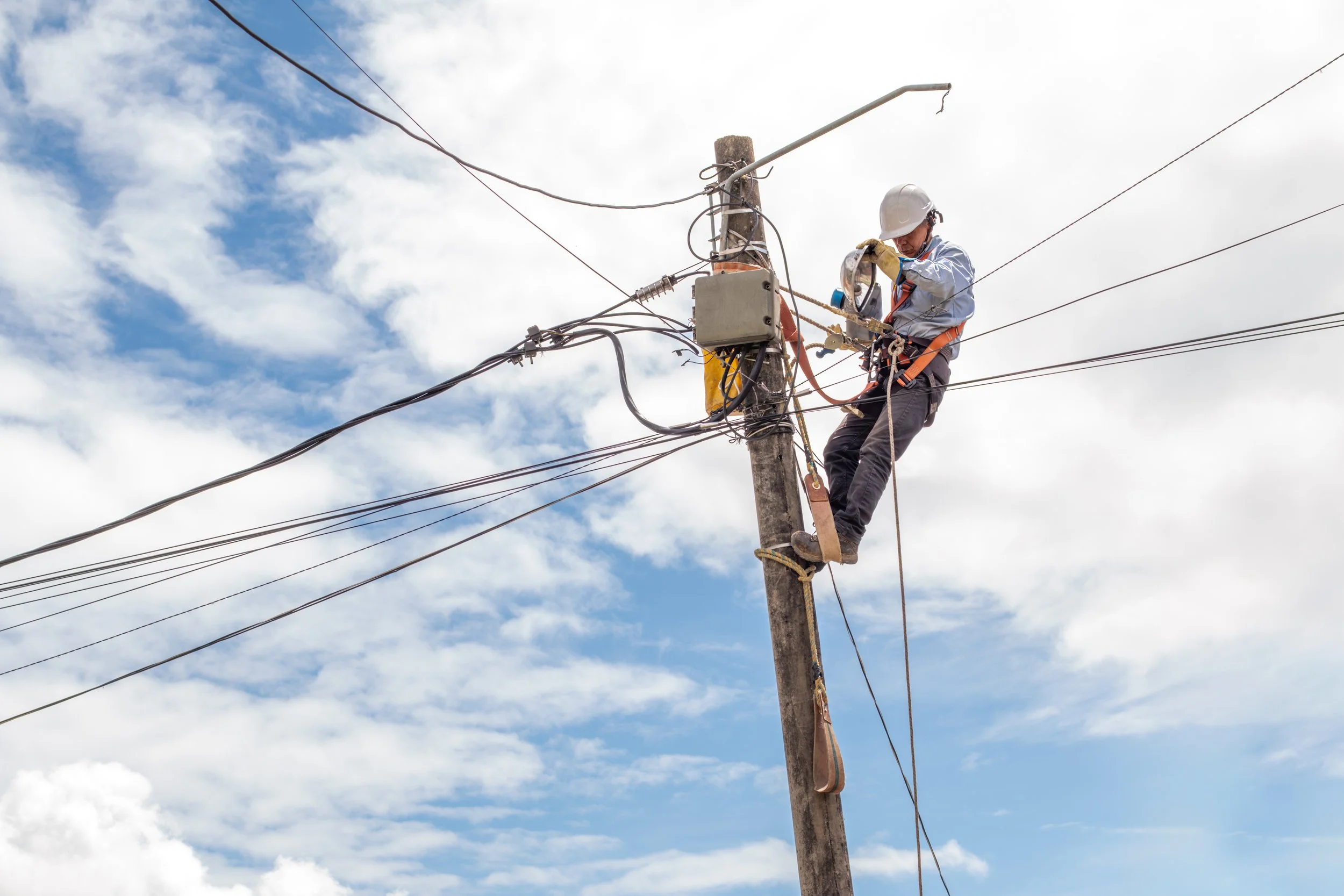
Copper does not evaporate. Where it runs on poles, it has to come down, and something has to go up.
The replacement path for most of this plant is fiber to the premises along the same routes. The poles are already there. The right of way is already established. The service addresses have not moved. That is close to the ideal profile for a lashed aerial build, and it means the volume of work created by copper retirement lands disproportionately on aerial crews rather than on any other kind.
The removal side is its own scope of work. Decommissioned copper still occupies space on the pole, still carries weight, and still has to be handled safely near energized conductors. Somebody has to go get it.
The pole space dividend nobody is talking about
Here is the second-order effect worth understanding.
Every strand of retired copper that comes off a pole frees space in the communications zone. That space is exactly what new attachers have been fighting over for the last three years. When a carrier clears its legacy plant from a route, the make-ready picture on that route changes for everyone else who wants to attach there.
Our post on make-ready engineering covers why crowded poles drive rearrangement and replacement costs. Copper retirement is one of the few forces currently working in the opposite direction. A pole line that was too congested to accept a new attachment in 2024 may be a straightforward application in 2027 because the copper came down in between.
This will not be evenly distributed. Retirements are happening wire center by wire center, so one township can open up while the next one over stays exactly as tight as it was. Route-level knowledge beats regional assumptions here.
The records problem is about to get worse before it gets better
When a carrier retires copper on a route, the thing that comes off the pole and the thing shown in the record are frequently not the same.
Decades of attachments, abandoned drops, and undocumented rearrangements accumulate on old plant. Retirement is the moment all of that surfaces, usually while a crew is standing in a bucket looking at something that is not on the print. Our post on what a proper as-built package should contain applies directly here, because the new fiber going up on that route deserves better documentation than the copper it replaced ever had.
The organizations that come out of this transition well will be the ones that treat the retirement as a chance to establish an accurate record rather than as a demolition task to get through.
What municipalities should be doing
Find out whether your municipality contains buildings with systems still riding copper. Fire alarm panels, elevator emergency phones, and security circuits are common holdouts, and a life-safety line that goes quiet is a code problem before it is a communications problem. That is a facilities question rather than a construction question, but it lands on the same desk in most boroughs.
Watch for retirement notices at the state level rather than waiting for a letter. The 180-day clock to governments starts before the 90-day clock to residents, which gives an attentive municipality a real head start on constituent questions.
And recognize that the fiber replacing that copper is a construction project in your right of way, with the same permitting and coordination demands as any other build.
What this means for providers and contractors
Copper retirement work runs on carrier capital rather than grant funding, which means it moves on a different schedule and answers to a different approval process. It is also happening at the same time as the federally funded builds, competing for the same aerial crews in the same territories.
That is the part worth planning around. The constraint on this work is not going to be money or authorization. It is going to be how many qualified crews can be in a bucket at once, and that number does not scale quickly.
The copper is coming down either way. The question is who is standing on the pole when it does.
Planning copper-to-fiber replacement work on existing pole line? TermLink Solutions provides turn-key aerial fiber construction, splicing, and testing for ISPs, municipalities, and businesses nationwide, with crews based in Central Pennsylvania. If you have routes coming out of retirement and need a crew that can build them cleanly and document them properly, contact our team.
