

Grounding and Bonding Aerial Fiber: Lightning Protection That Holds Up in Storm Season
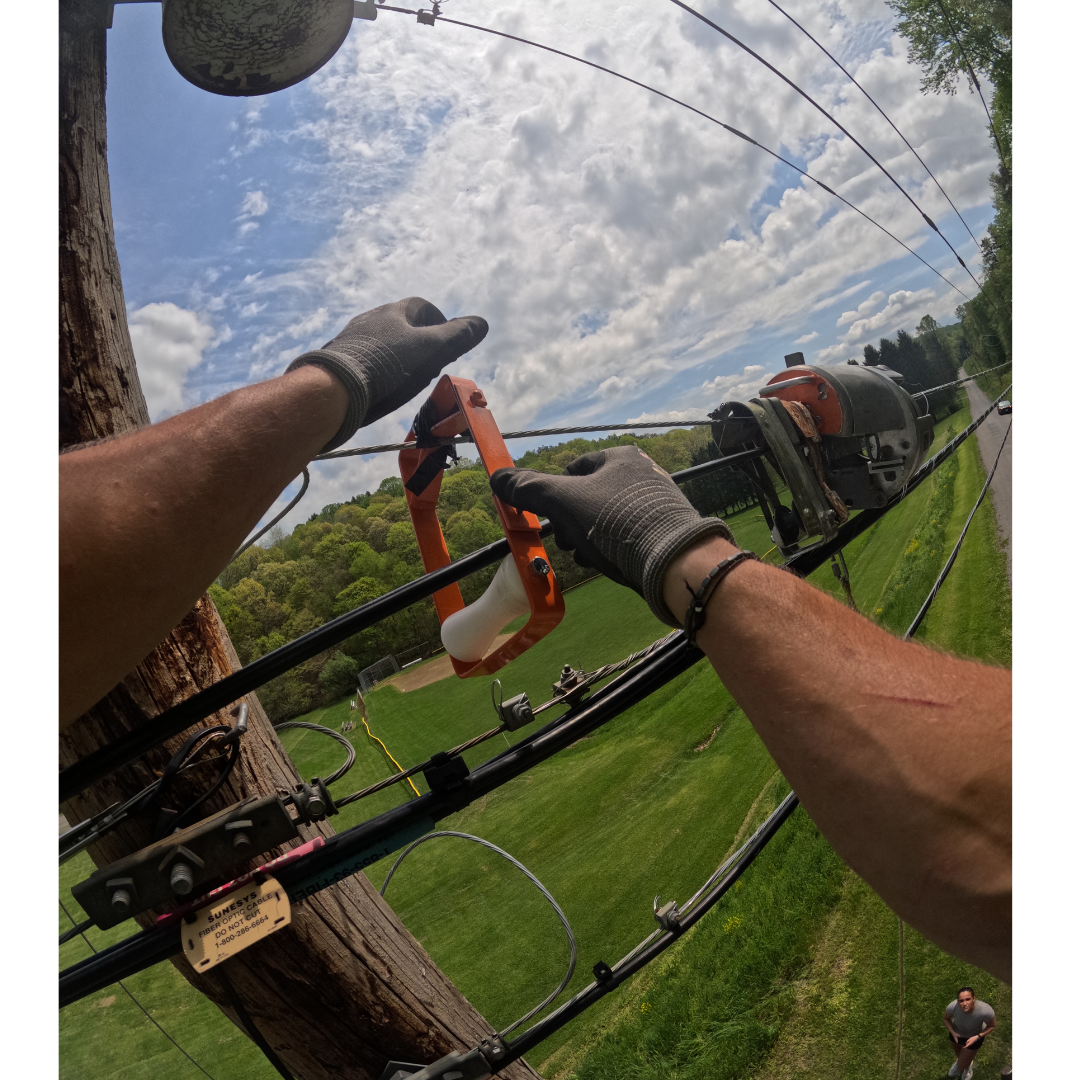
Fiber carries light, not electricity, so grounding can feel like a concern that belongs to the power company and not to a fiber crew. That instinct is exactly what gets equipment destroyed in a thunderstorm. A lashed aerial line is not made of glass from end to end. The steel messenger strand that carries the cable runs metal the entire length of the route, and a steel wire strung between poles for miles is precisely the kind of thing a storm finds. Bonding and grounding that metal is what gives a lightning strike a path to earth instead of a path through the network gear at the ends of the line.
Storm season in the Northeast brings the frequent lightning that turns a quiet design detail into the thing that decides whether a build survives the summer. This guide explains the metal hiding inside an aerial fiber line, the difference between bonding and grounding, and how to get the connection right in the field. It is the preventive side of the work covered in our guide to storm fiber restoration, because the cleanest restoration is the strike that never reaches the equipment in the first place.
The Metal Inside an "All-Glass" Line
The optical fiber itself is dielectric, meaning it conducts nothing, but a strand-and-lash build is built around a steel messenger. That messenger is a continuous metallic conductor for the whole run, and many fiber cables add their own metallic strength members or armor on top of it. Every one of those metal elements can pick up and carry electrical energy, which is why code treats them as something that has to be controlled rather than ignored.
There is one aerial cable that escapes this entirely. An all-dielectric self-supporting cable, known as ADSS, contains no metal at all and needs no grounding, which is one of the reasons utilities reach for it in the supply space. The AFL white paper comparing ADSS to strand and lash lays out that tradeoff in detail. A strand-and-lash build does not get that pass. The moment a metallic messenger goes up, bonding and grounding become part of the job rather than an option.
Bonding and Grounding Are Two Different Jobs
The two words get used interchangeably, and they should not be. Bonding is the work of electrically connecting the metallic parts to each other so the whole system sits at one common potential and carries current as a continuous path. Grounding is the separate act of connecting that bonded system to the earth so the energy has somewhere to go.
On an aerial line, bonding means making the messenger strand electrically continuous along its full length, including across the points where it dead-ends or splices, and tying it to the other suspension strands sharing a pole. Grounding then connects that continuous strand to the earth through a pole ground or the utility's grounding system. According to a manufacturer procedure for grounding metallic cable components, the suspension strand at the pole is made electrically continuous throughout its length and grounded at the locations the outside-plant engineer specifies, and where it ties to a multigrounded neutral on a pole with no vertical ground wire, a length of bare copper bonding conductor is left coiled to reach it. The National Electrical Safety Code is the governing authority that sits behind those practices.
Why Lightning Makes This Non-Negotiable
Picture what a long metallic messenger does during a storm. A direct strike or even a nearby one induces a surge of high voltage into that wire, and the energy then travels the line looking for the easiest path to ground. If the strand is properly grounded, that path runs straight into the earth and the surge dissipates harmlessly. If it is not, the energy keeps moving until it finds a way out, and the way out is often through the splice closures and the network equipment connected at the ends of the run.
Equipotential bonding is the principle that keeps this from happening. When every ground electrode along the route is bonded together, the whole system rises and falls in voltage as one unit, so there is no difference in potential for the surge to arc across. The opposite of that, a stray ground rod driven in isolation and never bonded to the existing system, can actually create a voltage difference between two grounds and make the problem worse rather than better. Grounding done halfway is sometimes more dangerous than no grounding at all.

Getting the Connection Right in the Field
A sound bond starts with the hardware. The crew strips a short length of messenger for a listed bonding clamp, and it does that carefully so the knife never cuts into the zinc coating that protects the steel from corrosion. A nicked coating invites the rust that will eat through the connection over a few seasons. The bond runs through bare copper conductor to the pole ground or the multigrounded neutral, and the whole connection gets weatherproofed so moisture cannot work it loose.
On a joint-use pole shared with power, the strand has to be bonded into the utility's grounding scheme rather than grounded on its own. This is the same shared-pole reality behind the strain insulators discussed in our anchoring and guying work, where an ungrounded or poorly bonded metallic element near energized conductors becomes a hazard to the public and the crew alike.
Where Grounding and Bonding Go Wrong
The most common failure is trusting the strand grip to carry continuity. A dead-end grip holds the strand mechanically, but it is not a bonding connection, so a line that looks continuous can be electrically broken at every termination. A close relative of that mistake is skipping the bonds at splice points, which leaves long sections of messenger floating and unprotected. The isolated ground rod is the failure that feels like diligence while quietly creating the potential difference it was meant to prevent. The slowest failure is a corroded or loosening clamp that tests fine on installation day and opens the ground path a few storms later, right when it is needed most.
The Ground Path Is the Quiet Insurance Policy
Bonding and grounding never show up in a speed test and never impress anyone driving past the line. They earn their place exactly once, in the seconds during a strike, and by then it is far too late to wish they had been done right. A line that is bonded continuously and grounded into a single equipotential system is a line that shrugs off the storm that takes down its poorly built neighbor.
TermLink Solutions builds aerial fiber with the ground path treated as part of the design, with crews who bond the messenger continuously, ground it into the utility system correctly, and protect every connection against the corrosion that undoes it. If you want an aerial build engineered to survive storm season rather than just pass inspection in fair weather, reach out to our team and let's make sure the line is protected before the first storm tests it.
