

A Span Fails After You Accepted the Job. Who Pays to Find It and Fix It?
The short answer is that it depends on why it failed, and the honest answer is that most contracts do not make that as clear as either party assumes.
The good news is that the structure is knowable. Responsibility after acceptance breaks down, and if you understand the categories before you sign, you can write a contract that resolves the question in an afternoon instead of in a dispute.
This describes how these provisions are commonly structured in construction contracting. It is not legal advice, and the terms that actually govern your project are the ones in your contract and the law of your state.
Acceptance is a legal event, not a formality
Acceptance is the moment risk shifts. It typically transfers responsibility for the completed work to the owner and starts whatever clocks the contract defines.
That makes what you require before signing acceptance consequential. Acceptance should be conditioned on complete test results, the as-built package, submitted redlines, and a closed punch list. Signing acceptance to release a payment milestone while documentation is still outstanding gives away the leverage you would need later.
It also matters whether your contract distinguishes substantial completion from final acceptance, because different provisions can run from different milestones. Federal construction contracts illustrate the point directly. The standard federal warranty of construction clause runs for one year from the date of final acceptance, and if the government takes possession of part of the work earlier, the clock on that portion starts when possession is taken.
Cause decides who pays
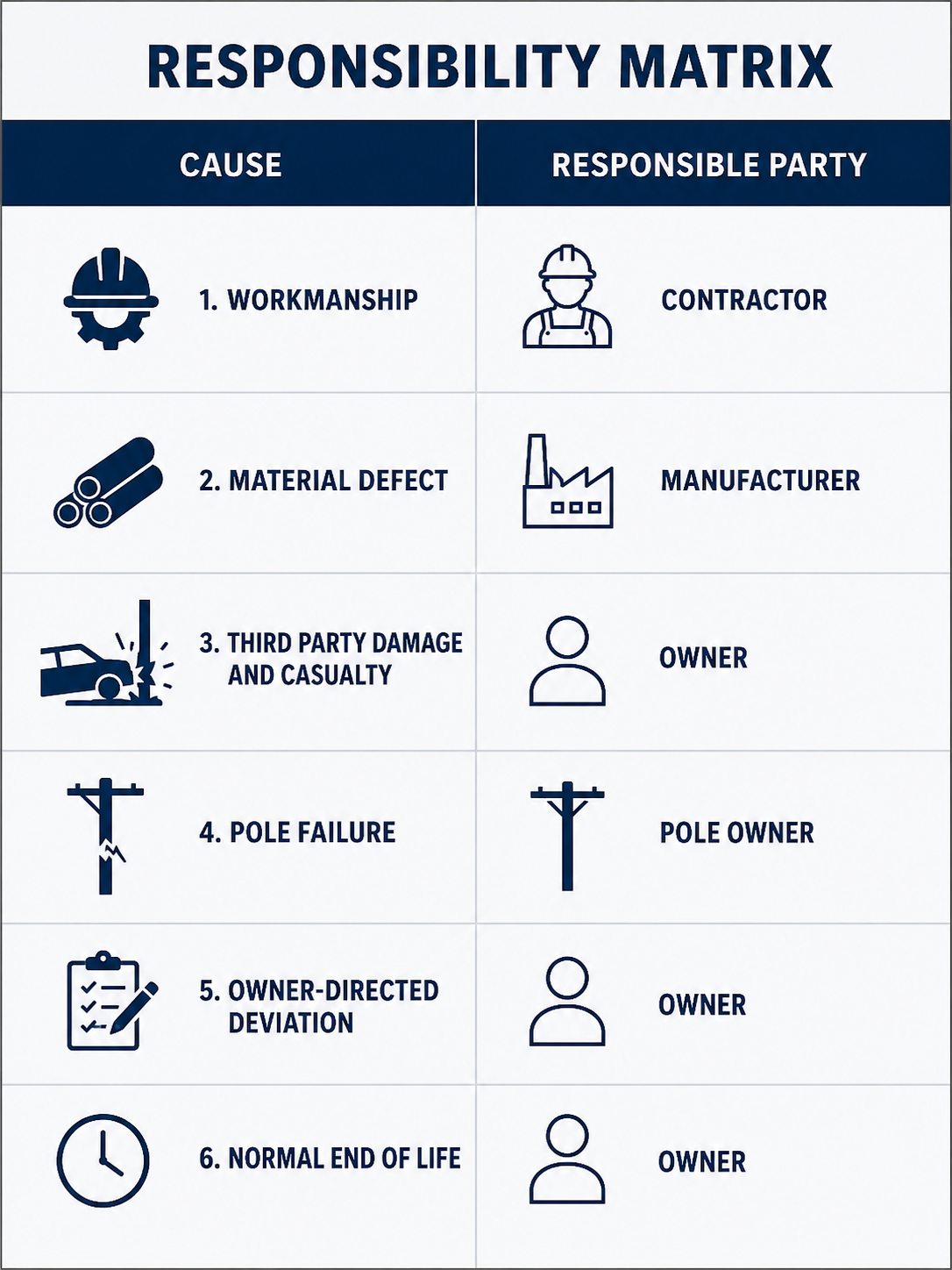
Nearly every post-acceptance dispute is really an argument about cause. The categories are reasonably clean.
Workmanship defects belong to the contractor. A splice that was marginal at acceptance and degraded, a cable lashed improperly, a span tensioned outside specification, a closure that was not sealed correctly, an attachment that does not hold the required clearance. These are failures of the work itself.
Material and manufacturing defects belong to the manufacturer, through whichever warranty applies. A cable with a defect from the factory or a closure whose seal fails within its rated life is not a workmanship problem.
Third party damage and casualty belong to the owner, subject to recovery. Storm damage, a vehicle strike, a tree fall, vandalism, a gunshot through a span. These are not defects at all. The owner restores and pursues the responsible party or an insurer where one exists.
Pole failures generally belong to the pole owner. If the structure came down, the attacher's cable failed because the pole failed, and that is a different conversation entirely.
Owner-directed deviations belong to the owner. If the owner instructed a departure from specification, the contractor who complied is not warranting the outcome of that instruction.
The normal end of life belongs to the owner. A plant has a service life, and reaching it is not a defect.
The one-year warranty is widely misunderstood
This is the part that surprises people on both sides of the table.
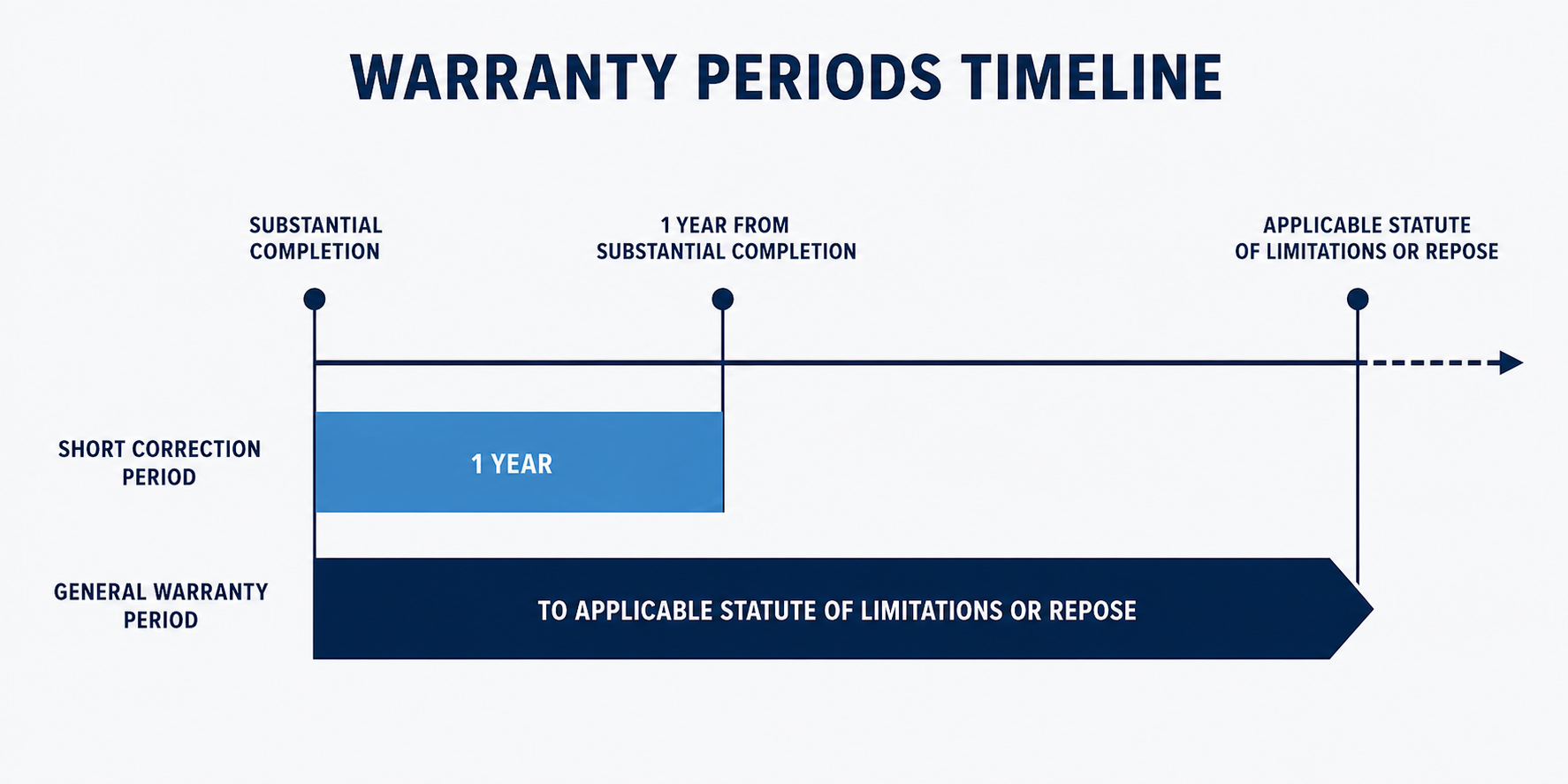
Industry standard construction forms typically contain two separate provisions that get collapsed into one in conversation. There is a correction of work or callback provision, usually running one year from substantial completion, which obligates the contractor to return and fix defective work discovered in that window. Separately, there is a general warranty that the work will be performed in a workmanlike manner and be free from defects.
The correction period has a deadline. The general warranty frequently does not. The practical consequence is that after twelve months a contractor may no longer be obligated to physically come back and perform the repair, while remaining financially liable for defective work until the applicable statute of limitations or repose runs, which is measured in years rather than months.
Owners who believe their recourse ended at twelve months sometimes give up a valid claim. Contractors who believe their exposure ended at twelve months sometimes get an unwelcome surprise. Both readings come from treating the callback period as the whole warranty.
Manufacturer warranties on materials and equipment run on their own terms and are generally not cut off by the construction contract's correction period unless the contract says so expressly. Assignment of those warranties to the owner at closeout should be a named deliverable rather than an assumption.
Documentation is what settles causation
Here is the practical center of the whole question.
If a span passes bidirectional acceptance testing with per-event data captured, and it fails eight months later, comparing the new trace against the acceptance baseline shows where the failure is. If the event sits exactly at a splice the contractor made and that splice read clean at acceptance, that is a workmanship conversation. If the event sits mid-span where a vehicle hit the pole line, it is not.
Without acceptance testing, causation is not provable by either party. The argument stops being about evidence and becomes about leverage, and leverage arguments are expensive and slow regardless of who is right.
This is the reason a thorough acceptance test protects the contractor at least as much as the owner. A documented baseline is a defense. Contractors who resist Tier 2 testing to save time on a project are giving up the only record that could later demonstrate their work was sound.
Latent defects are the specific risk this addresses. A splice that is within budget at acceptance but marginal in absolute terms can survive testing and then degrade through a few seasons of thermal cycling on an aerial plant. Per-event acceptance data makes that splice visible on day one, when it costs a reopen rather than an outage.
Retesting: who does it and who pays for it
Contracts frequently define the repair obligation and leave the diagnostic obligation undefined, which is where friction starts.
The workable structure is to say it plainly. The owner or the owner's contractor performs initial fault isolation. If the fault is determined to be a warranty defect, the original contractor performs the repair at no cost and reimburses the reasonable cost of the diagnostic work. If it is not a warranty item, the owner bears both, and the original contractor may still be the fastest party to perform the repair under agreed rates.

Two details are worth naming in the same clause. Response time during the warranty period, because an obligation to repair with no time commitment is not useful during an outage. And whether a warranty repair restarts the warranty on that segment. The federal clause takes a clear position on this by running a fresh one year period from the date of repair or replacement, which is a reasonable model.
What to put in the contract
Define acceptance criteria explicitly, including test results, documentation, and punch closure, and tie retainage release to acceptance rather than to substantial completion.
Define the correction period and the warranty separately, and say which milestone starts each.
Define exclusions in plain terms, since typical language voids coverage for abuse, neglect, improper maintenance, and work performed by others. On an aerial plant, work by others is not hypothetical, because other attachers touch the same strand.
Define response time during the correction period.
Define who pays for diagnostics and how it reconciles once cause is determined.
Require assignment of manufacturer warranties at closeout, with documentation.
State whether a warranty repair restarts the period on the repaired segment.
The practical takeaway
The question of who pays is answered by cause, and cause is answered by documentation. An owner with acceptance test results and a current as-built can determine responsibility quickly. An owner without them is negotiating.
Write the acceptance criteria and the warranty terms before the work starts, when both parties are reasonable, rather than discovering the gaps while a customer is out of service.
TermLink Solutions builds, splices, tests, and documents aerial fiber plant for ISPs, municipalities, businesses, and private landowners nationwide. We deliver full acceptance test data on every project, because a clear record of what was handed over serves both sides when something fails later.
