

Beyond Storm Response: Preventive Aerial Fiber Inspections That Catch Problems Before They Fail
Most conversations about aerial fiber maintenance start after something has already failed. A storm takes down a span, a vehicle hits a pole, a tree limb snaps a strand, and crews scramble to restore service while customers wait. Reactive restoration is a necessary part of operating outdoor plant, but it is not the whole picture. The networks that run cleanest year after year invest in preventive aerial inspections, catching problems during calm weather before they become outages during the next storm.
For ISPs, municipalities, electric cooperatives, and rural broadband operators, preventive inspection is not an optional add-on. It is the maintenance discipline that separates networks with predictable operating costs from networks that live in permanent crisis mode. This guide covers what preventive aerial fiber inspection involves, what it finds, how often it should happen, and why it consistently costs less than waiting for failures to surface on their own.
What Preventive Aerial Fiber Inspection Actually Looks For
A preventive inspection is a systematic visual and technical review of the entire aerial plant, span by span, conducted on a planned schedule rather than in response to a failure. The goal is to identify conditions that have not yet caused an outage but will eventually cause one if left uncorrected. Inspectors work through a defined checklist covering the cable, the attachment hardware, the poles and guys, the clearance envelope, and the surrounding vegetation.
On the cable itself, inspectors look for jacket damage from UV exposure, abrasion from wind-driven contact with vegetation, impact damage from thrown objects or gunfire in rural areas, and signs of squirrel or bird damage at support points. Jacket damage that has not yet reached the fiber core is easy to patch. Jacket damage that has allowed water intrusion into buffer tubes is significantly more expensive to repair and eventually degrades the fiber inside.
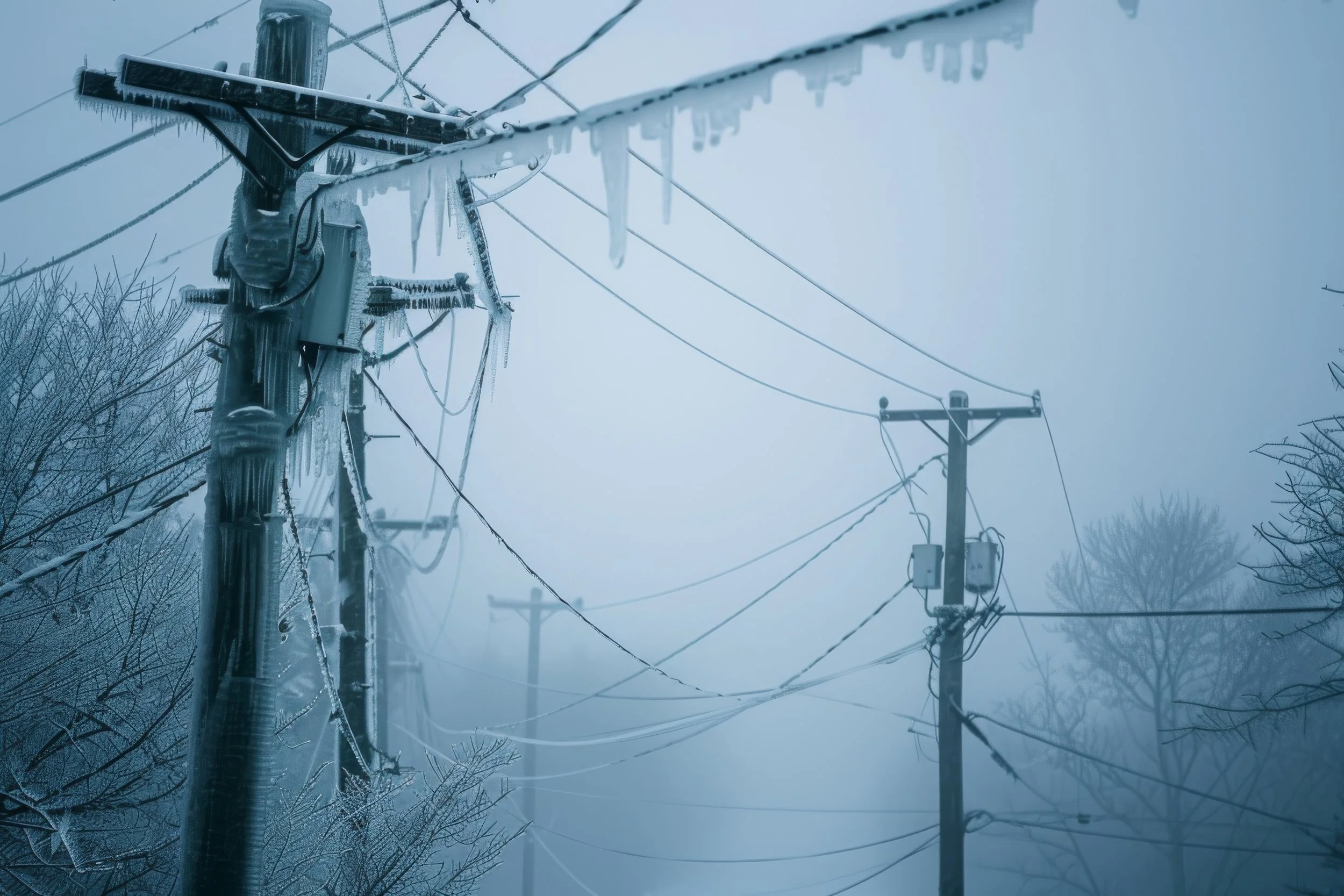
On the attachment hardware, inspectors check that dead-end clamps are properly torqued, suspension hardware is not worn or corroded, lashing wire is intact, and grounding connections at bonded spans are secure. Hardware failures rarely give dramatic warnings. A suspension clamp that is slowly corroding looks fine from ground level until the day it lets go, typically during the first heavy ice event after corrosion crosses a critical threshold.
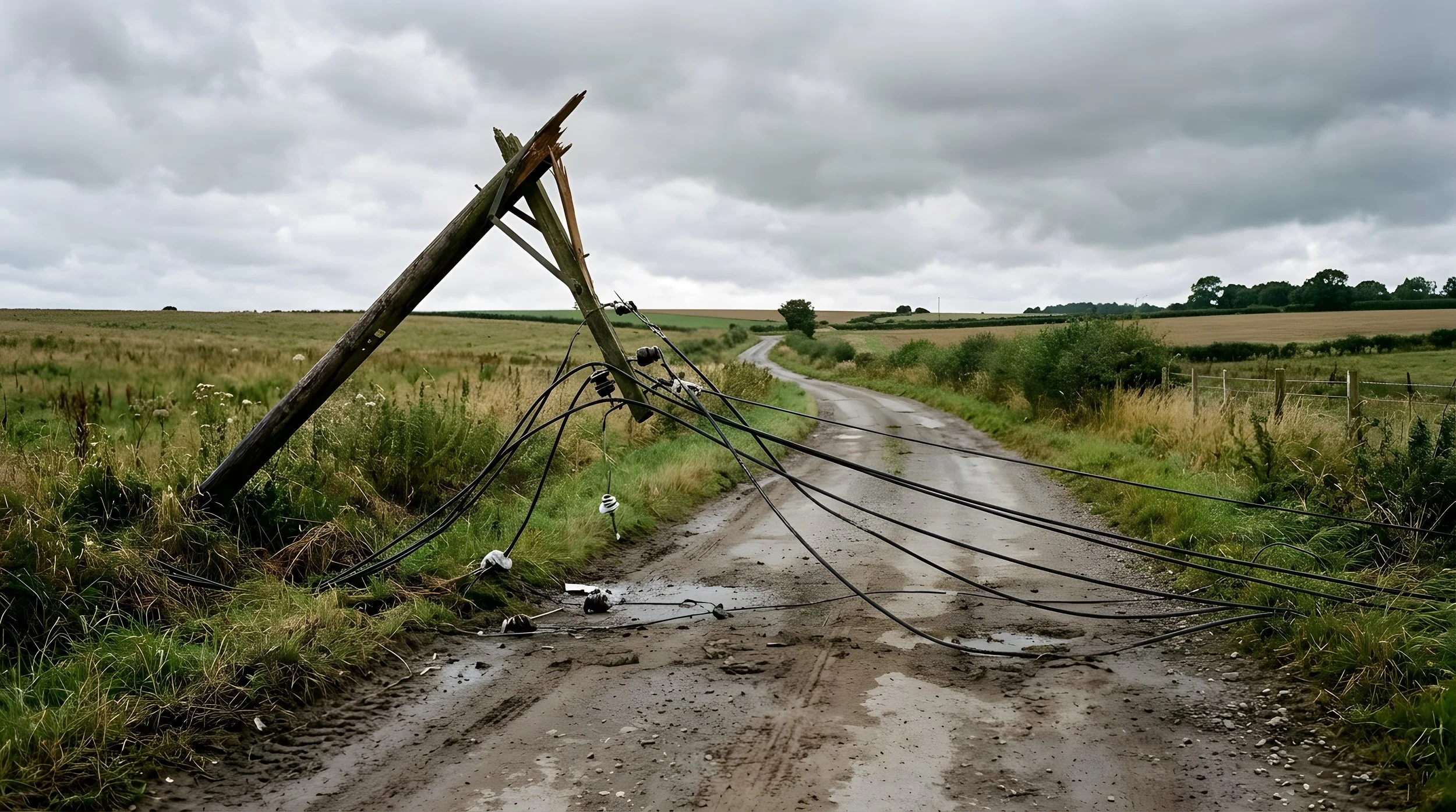
On the poles and guys, inspectors look for lean, rot at ground level, cracks or splits in wood poles, damage to guy wires or anchors, and any indication that structural integrity has been compromised by age, accident, or weather. A pole that is slowly rotting at groundline will carry its normal load for years before failing under a storm that a healthy pole would have handled.
On clearance, inspectors measure actual vertical clearance over roadways, driveways, and pedestrian areas, and horizontal clearance from buildings and other structures. Clearances that met code at installation do not always stay compliant over time. Cable sag increases with age, ground elevations shift from erosion or construction, and new structures get built under existing spans. A clearance violation discovered during preventive inspection can be corrected on a planned schedule. A clearance violation discovered by a truck snagging the cable becomes a restoration project.
On vegetation, inspectors identify tree limbs that have grown into contact with the cable, tree trunks that threaten a span during wind events, and dead or dying trees within falling distance. Vegetation management is the single largest source of weather-related aerial fiber outages, and it is the one that responds most reliably to preventive action.
How Preventive Inspection Gets Done in the Field
Traditional aerial fiber inspection is a ground-based visual exercise. A two-person crew walks or drives the line, stopping at each pole to examine the attachment hardware, the cable at the support point, and the span extending to the next pole. Binoculars help with elevated views, and climbing belts or bucket trucks handle spot inspections requiring closer access. The work is methodical and slow but generates a detailed, pole-by-pole record that supports maintenance planning.
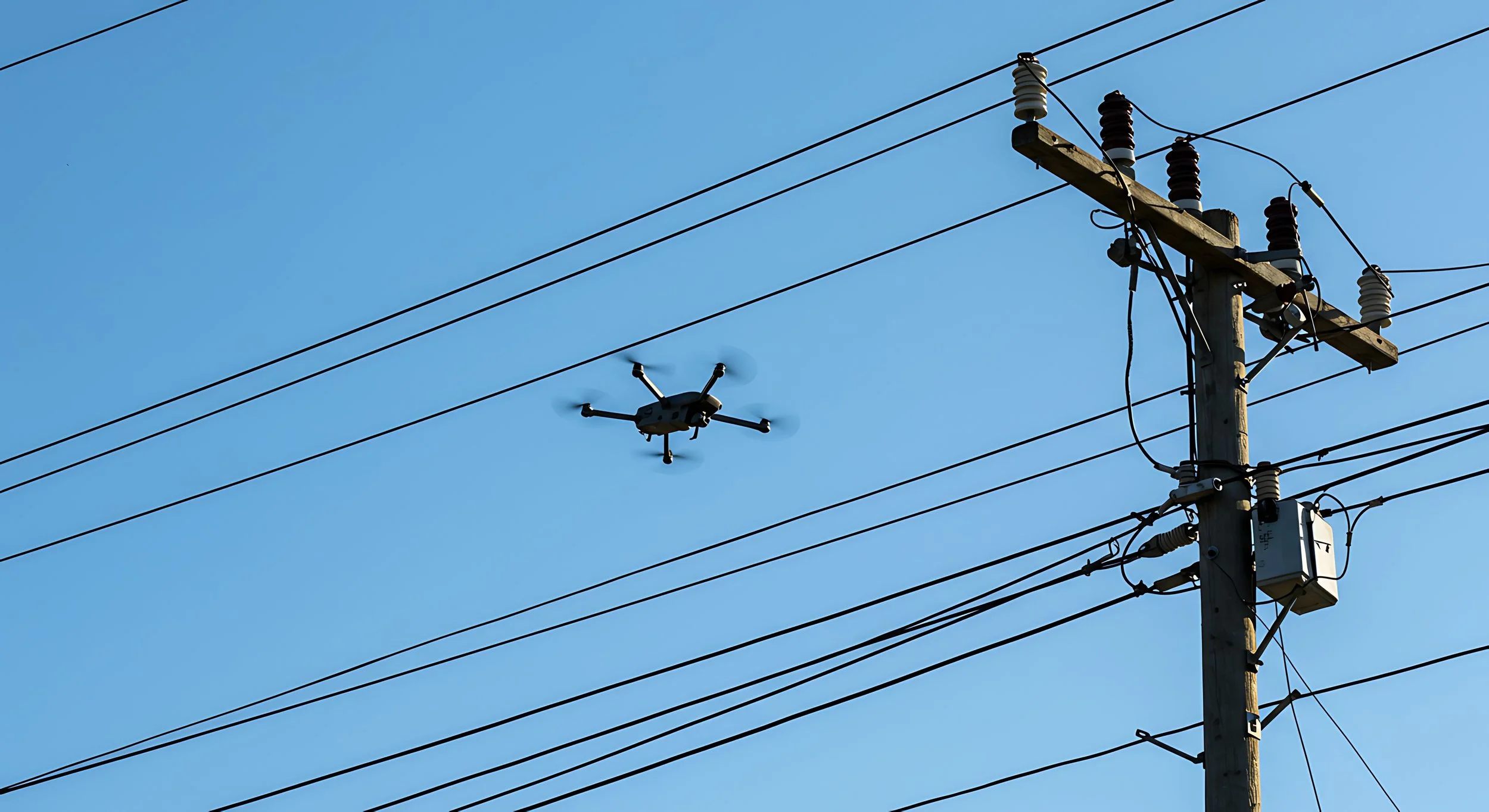
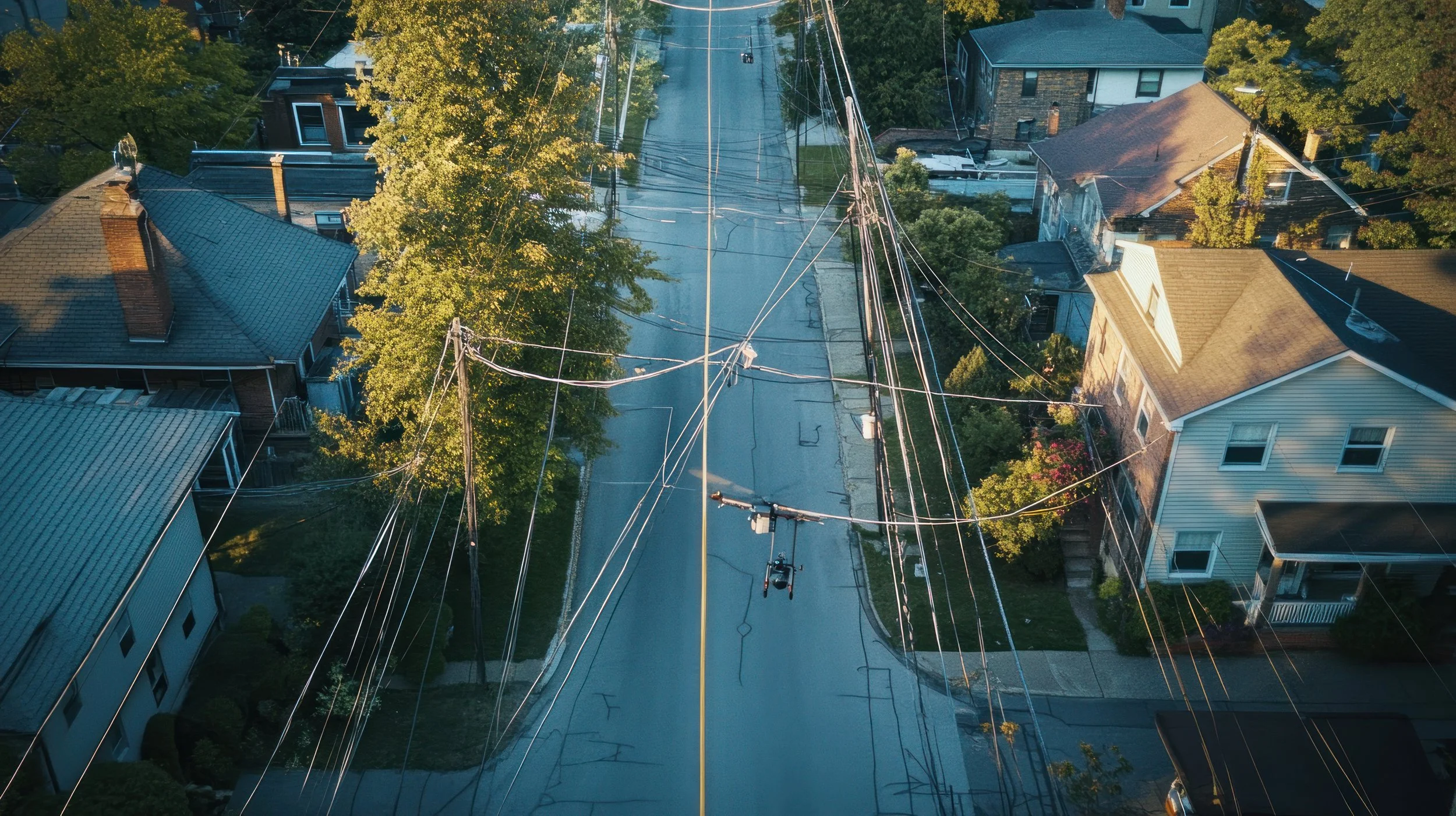
Drone-based inspection has become increasingly common on longer runs and in difficult terrain. A drone equipped with high-resolution cameras, thermal imaging, and in some cases LiDAR can fly a span in a fraction of the time a ground crew takes, capturing imagery for later review by engineering staff. Drones are particularly useful for spotting vegetation encroachment above the cable line, detecting hot spots at connection points that indicate resistance failures, and mapping cable sag across long spans. Drone-collected data can be archived to support year-over-year comparison, which makes gradual degradation visible.
LiDAR scanning is the highest-resolution inspection tool available for aerial plant, creating three-dimensional point clouds of every pole, cable, and surrounding structure. LiDAR supports precise clearance measurement, vegetation volume analysis, and structural assessment of pole lean, and its use has grown as the equipment has become more affordable.
The three approaches are complementary rather than competing. A complete preventive inspection program combines ground-based crew walks with periodic drone or LiDAR surveys, and the data from all three feeds into a single asset management record that tracks every defect from discovery through repair.
How Often Aerial Fiber Should Be Inspected
The right inspection interval depends on the network's age, environment, and regulatory requirements. Electric utilities generally inspect their poles on multi-year cycles. As context, the FCC's 2023 pole attachment reforms require utilities to share their cyclical pole inspection reports with prospective attachers, formalizing what had long been informal industry practice. For the fiber attachments themselves, most operators should be running a full visual inspection annually and a more thorough hardware and clearance audit every three to five years.
Higher inspection frequency makes sense for networks in severe weather corridors, networks carrying critical traffic, networks with aging hardware, and networks attached to utility poles that have experienced high failure rates. Lower frequency can work for younger networks in benign environments with stable vegetation, though skipping annual inspection entirely is almost never the right call.
The interval that matters less than total frequency is the timing within the year. Inspection should happen before the seasonal weather events that tend to expose weaknesses. In the Northeast, that means inspection before the winter ice and wind season, giving the maintenance crew time to correct findings before storms arrive. An inspection conducted in January after the first storm of the season has already revealed the weak points is less a preventive program than a post-mortem.
What Preventive Inspection Prevents
The most direct benefit is outage reduction. Networks with active preventive inspection programs consistently experience fewer weather-related outages, fewer hardware failures, and faster restoration times when outages do occur. The combination of finding and fixing problems early and having up-to-date asset records to work from compounds over time.
The second benefit is regulatory compliance. Federal reporting requirements under the FCC's Network Outage Reporting System obligate qualifying communications providers to report significant service disruptions, and the pattern of reported outages factors into the Commission's analysis of network reliability. Operators with documented preventive inspection programs are in a stronger position during regulatory reviews, grant audits, and insurance renewals.
The third benefit is cost control. Reactive restoration work is expensive because it happens on emergency schedules with overtime crews, emergency equipment rental, and often damaged adjacent infrastructure that has to be repaired at the same time. Preventive maintenance happens on planned schedules with standard crew rates and stocked materials. The per-defect cost of preventive repair is typically a small fraction of the per-defect cost of emergency restoration.
The fourth benefit is network value preservation. A fiber network with documented maintenance history and current condition records is a substantially more valuable asset for refinancing, sale, merger, or grant application than a network whose condition is unknown.
What Inspection Programs Tend to Get Wrong
The most common failure is treating inspection as a compliance checkbox rather than an engineering exercise. A crew that walks the line, checks the boxes, and submits a report showing no defects may technically satisfy an inspection requirement without producing useful engineering information. Inspection programs that do not surface defects are either inspecting networks that genuinely have none, which is rare on aging aerial plant, or they are missing things that will show up later as outages.
The second common failure is not closing the loop on findings. An inspection that identifies 50 defects and produces no follow-up maintenance work orders has wasted the inspection budget entirely. Every identified defect should generate a work order, get prioritized against the maintenance backlog, and eventually get resolved with documentation. Inspection programs that produce defect lists without resolution tracking lose their value over time as the same defects keep reappearing in each annual report.
The third common failure is inconsistent inspection quality. Different inspectors, different equipment, and different checklists from year to year produce non-comparable data that makes trend analysis impossible. Programs that standardize on a consistent methodology, documentation format, and where possible personnel produce data that actually supports engineering decisions across multi-year time horizons.

Building a Preventive Inspection Program That Pays for Itself
The networks that run cleanest are not the ones with the newest cable or the highest construction standards. They are the ones with consistent, disciplined preventive maintenance programs that catch problems during calm weather and correct them before they become emergencies. Aerial fiber is a 30-year asset that responds to attention and punishes neglect.
TermLink Solutions provides preventive aerial fiber inspection services across Pennsylvania and beyond, combining experienced ground-based crews with drone-based survey capability and consistent documentation that supports long-term asset management. Our inspection programs find real defects, produce actionable maintenance work orders, and build a documented history of network condition that supports refinancing, regulatory compliance, and future expansion. If you operate an aerial fiber network and want to move from reactive storm response to preventive maintenance discipline, reach out to our team and let's build an inspection program that protects your network and your investment.
